

A diesel engine needs a steady supply of clean fuel to run correctly. The fuel must first travel from the tank to the engine. It then has to be raised to very high pressure before the injectors can spray it into the cylinders.
If something goes wrong during either step, the engine may lose power, run roughly, take longer to start, or set a trouble code. The hard part is figuring out which side of the system is causing the diesel low fuel pressure problem.
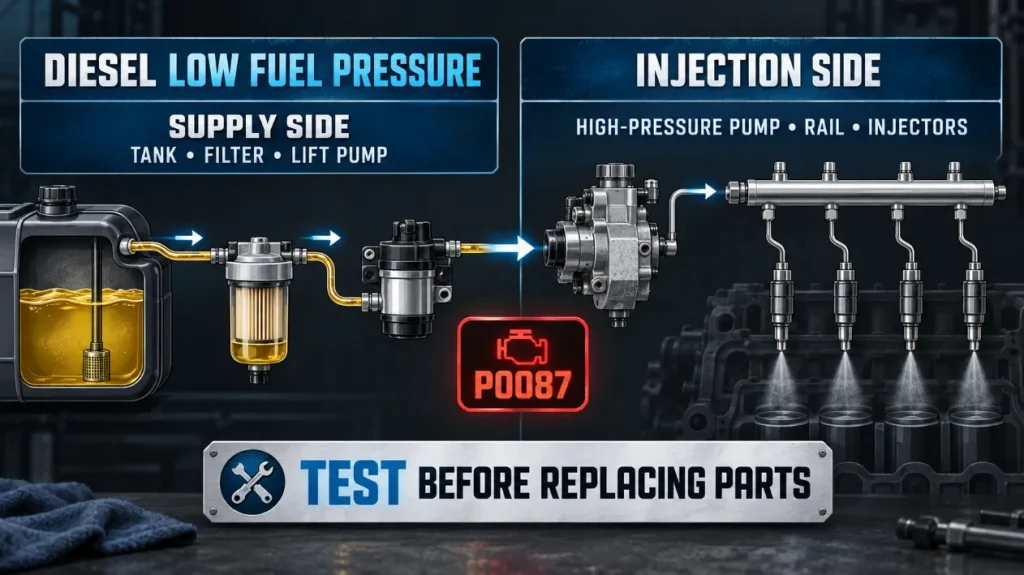
The low-pressure supply side and the high-pressure injection side work together, but they do different jobs. A weak lift pump can starve a healthy high-pressure pump. A worn injector can also cause rail pressure to drop even when the supply side is working normally.
At Kepkee’s Diesel & Performance, we believe good testing should come before replacing expensive parts. Understanding the two sides of the fuel system can help explain why.
Contact Us Now Today
How a Common-Rail Diesel Fuel System Works
A modern common-rail diesel fuel system has two basic sections.
The low-pressure side moves fuel from the tank toward the engine. Depending on the vehicle, it may include:
- The fuel tank
- A pickup tube or sending unit
- Fuel lines
- A lift pump
- One or more fuel filters
- A water separator
- Seals and fittings
The high-pressure side takes that fuel and raises it to the pressure needed for injection. This section normally includes:
- A high-pressure fuel pump
- The fuel rail
- A fuel pressure sensor
- A pressure control valve or regulator
- High-pressure lines
- Fuel injectors
- The engine control module
A failure on either side may create similar symptoms. That is why diesel low fuel pressure should be treated as a starting point for diagnosis, not as the final answer.
Common Symptoms of a Fuel Pressure Problem
Low fuel pressure diesel symptoms can change based on the engine, load, temperature, and severity of the problem.
A driver may notice:
- Long cranking before the engine starts
- Hard starting when the engine is warm
- Rough idle
- Hesitation during acceleration
- Weak power while towing
- Engine surging
- Stalling
- Increased smoke
- Limp mode
- A check engine light
The truck may run normally at idle but lose power while climbing a hill. It may also feel fine without a trailer and then struggle as soon as it is asked to work.
These symptoms do not automatically prove that the high-pressure pump has failed. Honestly, several problems can feel almost the same from the driver’s seat. A scan tool and direct fuel-system tests are usually needed.
Contact Us Now Today
Understanding the P0087 Diesel Code
P0087 generally means the measured fuel rail pressure is too low compared with the level expected by the engine computer.
The code tells us that the pressure did not meet the target. It does not tell us exactly why.
Possible causes may include:
- A restricted fuel filter
- A weak lift pump
- Air entering the fuel system
- A damaged fuel line
- Low fuel level
- A faulty pressure sensor
- A sticking pressure regulator
- A weak high-pressure fuel pump
- Excessive injector return flow
- Contaminated fuel
- A wiring or connector problem
A P0087 diesel code may appear by itself or with other fuel-system codes. Freeze-frame data can show the engine speed, load, and operating conditions present when the code was set. That information may be useful, especially when the complaint happens only during hard acceleration.
Clearing the code without testing the system does not fix the cause. It may only turn off the warning light for a short time.
Problems on the Low-Pressure Supply Side
The supply side has to deliver enough fuel to the high-pressure pump. If the incoming supply is weak, the high-pressure pump may not be able to build the requested rail pressure.
This can create a diesel low fuel pressure concern even when the injection pump itself is still capable of working.
A Restricted Fuel Filter
A clogged filter limits the amount of fuel reaching the engine. The truck might idle normally because idle does not require much fuel. During acceleration or towing, the restriction becomes more obvious.
Fuel filters are maintenance parts, but replacing one is not always the complete answer. Dirt, water, rust, or microbial growth in the tank may clog a new filter again. Finding heavy contamination in the filter means the rest of the fuel system may need attention.
A Weak or Failed Lift Pump
The lift pump moves fuel from the tank to the engine. Diesel lift pump failure symptoms may include hard starting, poor power under load, unusual pump noise, or low supply pressure.
Some pumps become weak slowly. They may still run and make noise, yet fail to deliver enough fuel volume. This is why listening for the pump is not a full test.
Pressure and volume may need to be measured under the conditions where the problem occurs.
Air Entering the Fuel System
The Air in a diesel fuel system can cause hard starting, rough running, or pressure loss. Air may enter through loose fittings, damaged seals, cracked hoses, a filter housing, or a problem near the tank pickup.
A small air leak does not always leave wet fuel on the ground. On the suction side of the system, air may be pulled inward without fuel leaking outward. That can make the problem harder to see.
Clear test lines, vacuum checks, or other model-specific tests may be needed to find it.
Problems on the High-Pressure Injection Side
Once fuel reaches the engine, the high-pressure pump has to raise it to the level requested by the engine computer. In a common-rail system, that pressure may change quickly as engine speed and load change.
High-side diesel low fuel pressure may come from the pump, control parts, injectors, sensor, or even the fuel arriving from the supply side.
A Worn High-Pressure Fuel Pump
Diesel high-pressure fuel pump symptoms can include long cranking, low power, stalling, rail-pressure codes, or a no-start condition.
A worn pump may build enough pressure at idle but fall behind when the engine needs more fuel. Internal damage may also send metal debris into the rail and injectors. That is a more serious situation because replacing only the pump may leave contamination elsewhere in the system.
Before blaming the pump, a technician should check whether it is receiving a proper fuel supply. A healthy pump cannot do its job if it is being starved by a clogged filter or weak lift pump.
Excessive Injector Return Flow
Diesel injectors receive high-pressure fuel, but some fuel normally returns through a return circuit. If one or more injectors allow too much fuel to return, the rail may struggle to hold pressure.
A diesel injector return-flow test measures and compares the amount of fuel returning from each injector. One injector with much higher return flow may be worn or damaged.
The test method and allowed amount vary by engine. The results should be compared with the correct specifications. Simply seeing fuel in a return line does not mean the injector is bad.
Contact Us Now Today

A Pressure Control or Sensor Problem
The engine computer depends on the fuel rail pressure sensor to report actual pressure. It then uses control valves or regulators to adjust the system.
A faulty sensor may report the wrong value. Wiring damage or a loose connector can create a similar issue. A stuck pressure control valve may also prevent the system from building or holding the requested pressure.
These parts should be tested before they are replaced. A scan-tool number can be useful, but it does not always show whether the pressure itself is wrong or the sensor is reporting it incorrectly.
Commanded vs. Actual Rail Pressure
One helpful part of common-rail fuel-pressure diagnosis is comparing commanded vs. actual rail pressure.
Commanded pressure is what the engine computer wants. Actual pressure is what the rail pressure sensor reports.
When the engine starts, idles, or accelerates, the two readings should generally follow each other within the limits set by the manufacturer. If actual pressure falls far behind the commanded value under load, there is a real clue to follow.
The pattern matters.
If pressure is too low during cranking, the engine may be slow to start or may not start at all. If pressure looks normal at idle but drops during acceleration, the system may have a flow restriction, weak pump, control problem, or excessive injector return.
A technician may record this data during a road test. Looking at a graph is often easier than trying to watch fast-changing numbers on a screen.
Why the Truck Loses Pressure Under Load
A common complaint is that the diesel loses fuel pressure under load.
At idle, the engine uses a small amount of fuel. A partly clogged filter or weak pump may still keep up. When the driver accelerates, climbs a hill, or pulls a trailer, fuel demand rises quickly.
That is when the weak part of the system shows itself.
A truck with diesel low fuel pressure under load may hesitate, lose boost, enter reduced-power mode, or set a P0087 code. It may recover when the driver releases the accelerator.
Testing only at idle could miss this problem. Supply pressure, fuel volume, and rail-pressure data may need to be checked during a controlled road test or other approved load test.
Safety matters here. Testing should be done with the correct equipment and by someone who understands high-pressure diesel systems.
Why Replacing Parts Too Early Can Get Expensive
Fuel-pressure symptoms sometimes lead people to replace the fuel filter first. That may be reasonable if the filter is overdue, but it is still only one possible cause.
If the problem remains, the lift pump may be replaced next. Then perhaps the rail sensor, regulator, or injectors. This type of guessing can become expensive quickly.
A better diagnosis looks at the system in order:
- Confirm the driver’s complaint.
- Scan for codes and review freeze-frame data.
- Check fuel quality and the filter.
- Inspect for air leaks or damaged lines.
- Test low-side pressure and volume.
- Compare commanded and actual rail pressure.
- Test the sensor and control circuits when needed.
- Check injector return flow.
- Evaluate the high-pressure pump after the supply side is confirmed.
The exact order may change depending on the truck and symptoms. Still, separating the low-pressure side from the high-pressure side prevents a lot of guesswork.
Fuel Contamination Can Affect Both Sides
Dirty fuel, water, gasoline mixed into diesel, or other contamination may damage more than one part of the system.
Water can reduce lubrication and cause corrosion. Debris may restrict the filter. The wrong fuel can damage pumps and injectors. Metal particles from a failing high-pressure pump may spread through the rail and return system.
If contamination is found, the repair may involve more than replacing the first damaged part. The tank, lines, rail, injectors, and other components may need inspection or cleaning based on the manufacturer’s repair process.
Continuing to run the engine may spread the damage. If the truck begins running poorly soon after a questionable fill-up, shutting it down and having it checked may prevent a larger repair.
Let Kepkee’s Diesel & Performance Diagnose the Cause
There is no single repair for every diesel low fuel pressure complaint. One truck may need a new filter. Another may have a weak lift pump, air leak, worn injector, faulty control valve, or damaged high-pressure pump.
The important part is finding out where the pressure loss begins.
Kepkee’s Diesel & Performance can inspect the low-pressure supply system, review rail-pressure data, and test related components to narrow down the cause. This helps avoid replacing costly diesel parts based only on a code or guess.
If your truck is hard to start, loses power while towing, or sets a fuel-pressure code, schedule a proper inspection. A careful diagnosis can show whether the trouble starts at the tank, inside the high-pressure system, or somewhere in between.